
How to Play Chess for Beginners: A Complete Step-by-Step Guide
Chess is considered one of the most popular mind games in the world, combining deep thinking, strategic planning, and decision-making at the right time. Although its rules may seem simple at first, mastering the game requires proper understanding and continuous practice.
If you are a beginner looking for an easy way to learn chess from scratch and understand how to play chess step by step, this guide will help you learn the basics of the game, understand how each piece moves, and discover how to start a match correctly so you can play with confidence and improve your skills over time.
What is Chess and Why Is It Considered One of the Best Mind Games?
Chess is one of the oldest and most popular mind games in the world. It is primarily based on deep thinking, analysis, and decision-making. It is played by two players on a board consisting of 64 squares, where each player moves a set of pieces according to specific rules, aiming to achieve “checkmate” against the opponent’s king—placing it in a position where it cannot escape or defend itself.
Chess does not rely on luck; it is entirely based on the player’s mental skills, making it one of the most powerful games for developing intelligence and improving thinking ability over time.
The game offers several important benefits:
1.Improves thinking and concentration skills
Chess forces players to think carefully before every move, which enhances focus and attention to detail, especially when anticipating the opponent’s responses.
2.Helps in making quick and well-planned decisions
During the game, players must make decisions within a limited time, which improves their ability to think quickly while maintaining accuracy.
3.Strengthens long-term planning skills
Chess is based on building strategies that extend several moves ahead, helping players develop forward thinking and connect actions with outcomes.
In addition, chess is used as an educational tool in many countries, where it is included in school curricula or activities due to its positive impact on developing thinking skills in both children and adults.
Chess Pieces and Board: Understanding the Board and the Pieces
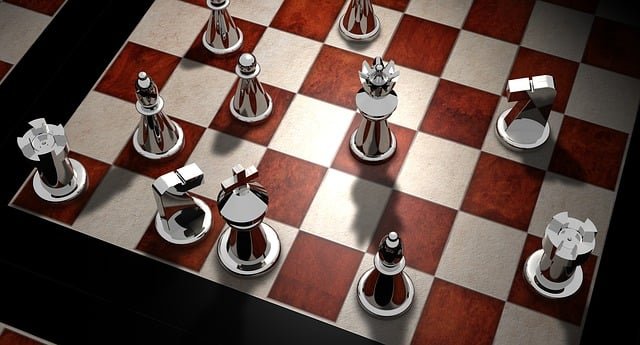
A game of chess consists of two main components: the board and the pieces. Each plays an important role in how the game is played and in understanding its rules correctly.
1.The Chess Board
The chessboard consists of 64 squares arranged in an 8×8 grid, with alternating light and dark colors.
It is positioned so that each player has a light-colored square in their bottom-right corner, which is important for setting up the game correctly.
2.The Chess Pieces
Each player has 16 pieces, and each piece has its own role and movement style within the game.
3.King
The king is the most important piece in chess. The main goal of the game is to protect it.
If the king is under threat with no possible escape, the game ends immediately.
4.Queen
The queen is the most powerful piece in chess. She can move in all directions over unlimited squares, making her a strong attacking piece.
5.Rooks
Rooks move in straight lines either horizontally or vertically. They are used for defense, attack, and controlling rows and columns.
6.Bishops
Bishops move diagonally. Each bishop stays on the same color square throughout the game, which requires strategic coordination between both bishops.
7.Knights
Knights have a unique L-shaped movement and are the only pieces that can jump over other pieces, making them very useful in complex positions.
8.Pawns
Each player has 8 pawns. They are the weakest pieces but very important.
Pawns move forward only, and they can be promoted to a stronger piece when they reach the opposite end of the board.
At the beginning of the game, all pieces are placed in a fixed setup: the main pieces are arranged in the back row, while the pawns form the front line, creating a balanced starting position for both players.
How Do Chess Pieces Move? A Simple Explanation for Each Piece
To understand chess correctly, you must first learn how each piece moves, as every piece has a different style that affects gameplay and strategy.
1.King
The king moves one square in any direction—horizontally, vertically, or diagonally.
Although its movement is limited, it is the most important piece because losing it means the game is over.
2.Queen
The queen is considered the most powerful piece in chess.
She can move in all directions over unlimited squares, as long as her path is not blocked, making her essential for attack and board control.
3.Rook
The rook moves in straight lines only, either horizontally or vertically.
It is used to control rows and columns, especially in the endgame.
4.Bishop
The bishop moves diagonally only, and each bishop stays on the same color squares throughout the game.
Therefore, both bishops are used together to cover more areas of the board.
5.Knight
The knight has a unique L-shaped movement: two squares in one direction and one square sideways.
It is the only piece that can jump over other pieces, making it very useful in closed or complex positions.
6.Pawn
The pawn moves one square forward and can move two squares on its first move only.
It captures diagonally, and when it reaches the last row of the board, it can be promoted to a stronger piece such as the queen.
Mastering how each piece moves is the first step to playing chess correctly. With practice, you will start using these movements to build strong strategies during the game.
Basic Chess Rules You Should Know
To understand chess correctly, it is important to know the basic rules that determine how the game is played and how it ends.
-
Check
A check occurs when a player’s king is under immediate threat of capture on the next move.
In this situation, the player must respond immediately by moving the king, blocking the attack, or capturing the attacking piece.
-
Checkmate
Checkmate happens when the king is under threat and there is no legal move to escape or defend it.
In this case, the game ends immediately, and the opponent is declared the winner.
-
Draw
A game can end in a draw under several conditions, such as when there are no legal moves and no check, when the same position is repeated multiple times, or when there are not enough pieces left to achieve a win.
-
Win
A player wins the game when they successfully place the opponent’s king in checkmate.
A win can also occur if the opponent resigns or runs out of time in certain types of games.
These rules form the foundation of every chess match. Understanding them well helps you play with confidence and make better decisions during the game.
Special Chess Rules (Castling – En Passant – Pawn Promotion)
Chess includes several special rules that add depth and strategy to the game. Understanding them helps you take advantage of important situations during a match.
-
Castling
Castling is a special move in which the king and a rook are moved at the same time.
The purpose of this move is to protect the king by placing it in a safer position while also activating the rook for the game.
Castling can only be done under certain conditions, such as neither the king nor the rook having moved before, and the king not being under attack during the move.
-
En Passant
En passant is a special pawn rule that occurs when an opponent’s pawn moves two squares forward from its starting position.
In this case, your pawn can capture it as if it had only moved one square.
This capture must be made immediately on the next move, otherwise the opportunity is lost.
-
Pawn Promotion
When a pawn reaches the last rank of the board, it can be promoted to any other piece such as a queen, rook, bishop, or knight.
In most cases, it is promoted to a queen because it is the most powerful piece in the game.
This rule gives the pawn great value despite being the weakest piece at the start.
Understanding and using these rules at the right time gives you a clear advantage and helps you control the flow of the game more effectively.
How to Start Your First Chess Game Correctly
The opening phase in chess is one of the most important stages, as it sets the tone for the rest of the game. A well-organized start increases your chances of control and success throughout the match.
-
Control the Center of the Board
The central squares are the most important because they give your pieces greater mobility and limit your opponent’s options.
Try to move your pawns and pieces early to control this area and gain an advantage in space and positioning.
-
Develop Your Pieces Quickly
It is important to bring your pieces such as knights and bishops into play as soon as possible so they can participate in both attack and defense.
Delaying development gives your opponent the opportunity to take control of the game.
-
Avoid Moving the Same Piece Repeatedly
Moving the same piece multiple times in the opening wastes time and slows down the development of your other pieces.
It is better to distribute your moves across different pieces to maintain balance and coordination.
-
Protect the King Early
It is recommended to castle early in the game to place your king in a safe position and connect your rooks for better defense.
Ignoring king safety can expose you to quick attacks from your opponent.
These basic principles help you start the game strongly and in an organized way. With practice, you will improve your style and build better strategies during play.
Best Chess Strategies for Beginners
To improve your chess level, it is important to follow a set of basic strategies that help you play smarter and avoid common mistakes.
-
Think Before Every Move
Do not move quickly without thinking. Always evaluate the board position before making a move.
Ask yourself what will happen after this move and how your opponent is likely to respond.
-
Watch Your Opponent’s Moves
Paying attention to your opponent’s moves helps you predict their plan and avoid traps.
It also allows you to find opportunities for attack or defense at the right time.
-
Do Not Attack Without a Plan
Random attacks often lead to losing your pieces easily.
It is better to build a gradual attack based on coordination between your pieces and supporting each other.
-
Protect Your Pieces and Avoid Unnecessary Losses
Every piece has value, and losing a piece without compensation puts you at a disadvantage.
Always try to protect your pieces and think carefully before sacrificing them.
Playing calmly and focusing on each move is the real key to improving in chess. With time, you will be able to build stronger strategies and achieve better results.
Common Mistakes Beginners Make in Chess
Many beginners in chess make mistakes that significantly affect their performance during the game and slow down their progress.
-
Moving the Same Piece Multiple Times in the Opening
Focusing on one piece wastes time and delays the development of other pieces.
It is better to develop all pieces quickly to participate in the game and control the board.
-
Ignoring King Safety
Neglecting the safety of the king can expose you to a quick attack that may lead to losing the game.
That is why it is important to castle early and place the king in a safe position.
-
Playing Without a Clear Plan
Random moves make your gameplay weak and unorganized.
You should always have a goal for each move, whether it is attacking, defending, or improving piece positioning.
-
Sacrificing Pieces Without a Reason
Losing a piece without compensation puts you in a difficult position.
Any sacrifice should be calculated and aimed at achieving a greater advantage, such as a strong attack or checkmate.
Avoiding these mistakes will help you improve quickly and make your playing style more organized and confident.
How to Improve Your Chess Level Quickly
If you want to improve in chess quickly, there are several important habits that can help you make noticeable progress.
-
Practice Daily
Regular practice, even for a short time each day, helps you reinforce the rules and improve your thinking speed over time.
-
Play Games Consistently
Every game you play gives you new experience and exposes you to different situations that help you learn in a practical way.
-
Analyze Your Mistakes After Each Game
Reviewing your games after finishing them helps you identify your mistakes and understand why you lost or performed poorly, allowing you to avoid them in future games.
-
Watch Professional Players
Watching professional matches helps you learn new ideas and strategies and understand how to handle different situations during the game.
Consistency in these steps is the most important factor in improving your level and reaching a higher stage.
Simple Exercises to Learn Chess Faster
You can improve your skills faster through practical exercises that enhance your thinking during the game.
-
Solve Chess Puzzles
Also known as tactical puzzles, these are short positions where you must find the best move.
They help improve your observation skills and ability to spot attacking opportunities.
-
Practice Basic Endgames
Learning how to play endgames with few pieces helps you win positions that might otherwise end in a draw.
-
Practice Real Game Positions
Training with positions similar to real matches helps you make better decisions during actual gameplay.
-
Try Different Strategies
Experimenting with different playing styles helps you discover what suits you best and broadens your understanding of the game.
These exercises help you improve your thinking and decision-making skills more quickly and accurately during matches.
Golden Horse Chess Academy for Teaching Chess
If you are looking for a structured and effective way to learn chess professionally, the Golden Horse Chess Academy is one of the options that helps develop skills gradually and clearly, from the beginner level up to advanced stages.
The academy follows a training approach that combines practical explanation with hands-on application, which helps learners understand the game faster and apply strategies in real matches.
Among the most important features of the academy:
-
Organized and easy online chess lessons
The academy provides online training content in a structured way suitable for all levels, making it easy for learners to follow lessons anytime.
-
Practical training on strategies and tactics
Learning is not limited to theory, as the focus is on practical application through real game positions that help improve decision-making skills.
-
Programs for children and adults
The academy offers different training programs suitable for various age groups, making learning accessible for both beginners and advanced players.
-
Continuous follow-up to improve player level
Students’ performance is regularly monitored to identify strengths and weaknesses and work on improving them consistently.
-
Clear training path from beginner to professional
The academy follows a structured training roadmap that starts from the basics and progresses step by step to advanced levels.
Whether you are just starting or looking to improve your level, joining a specialized academy helps you learn faster and saves you a lot of time and effort.
Professional Tips to Win Your First Chess Games
To increase your chances of winning:
- Do not rush your moves
- Try to understand your opponent’s plan
- Take advantage of your opponent’s mistakes
- Always focus on protecting your king
With time, you will start achieving better results.
Best Ways to Learn Chess from Beginner to Professional Level
You can learn chess through several methods, such as:
- Following online tutorials
- Joining a chess academy
- Learning with a professional coach
- Using chess apps
Choosing the right method helps you learn faster and more professionally.
Frequently Asked Questions About Learning Chess for Beginners
-
What is the best way to learn chess from scratch?
The best way is to start by understanding the basic rules and piece movements, then practice through real games. It is also recommended to follow tutorials or join a chess academy for structured training.
-
How long does it take to learn chess for beginners?
It depends on how consistent you are with practice. Basics can be learned in a few days, while reaching a good level may take weeks or months of regular practice.
-
Can I learn chess at home?
Yes, chess can be easily learned at home through online lessons, apps, watching games, and consistent practice.
-
Is chess difficult for beginners?
It may seem complex at first, but with gradual learning and practice, it becomes easy and enjoyable.
-
What is the most important advice for beginners?
Do not rush your moves. Always think before playing and focus on protecting your king while avoiding simple mistakes.
-
Do I need a coach to learn chess?
Not necessarily, but having a coach or joining an academy can significantly speed up your improvement and help avoid common mistakes.
-
What is the best age to learn chess?
Chess can be learned at any age, but children from 5 years and above can start easily and achieve great progress with practice.
-
How can I improve my chess level quickly?
Through daily practice, analyzing games, learning strategies, solving puzzles, and playing against different levels of opponents.